
Norman Island and the pirates of the BVI
Norman Island in the BVI is where the pirate stories have paperwork behind them. Spanish silver really was buried there in 1750, and officials from Tortola seized part of it soon after; Blackbeard turns up in a British governor's letters a generation earlier. Today the island is a mooring field, a beach restaurant and a floating bar.
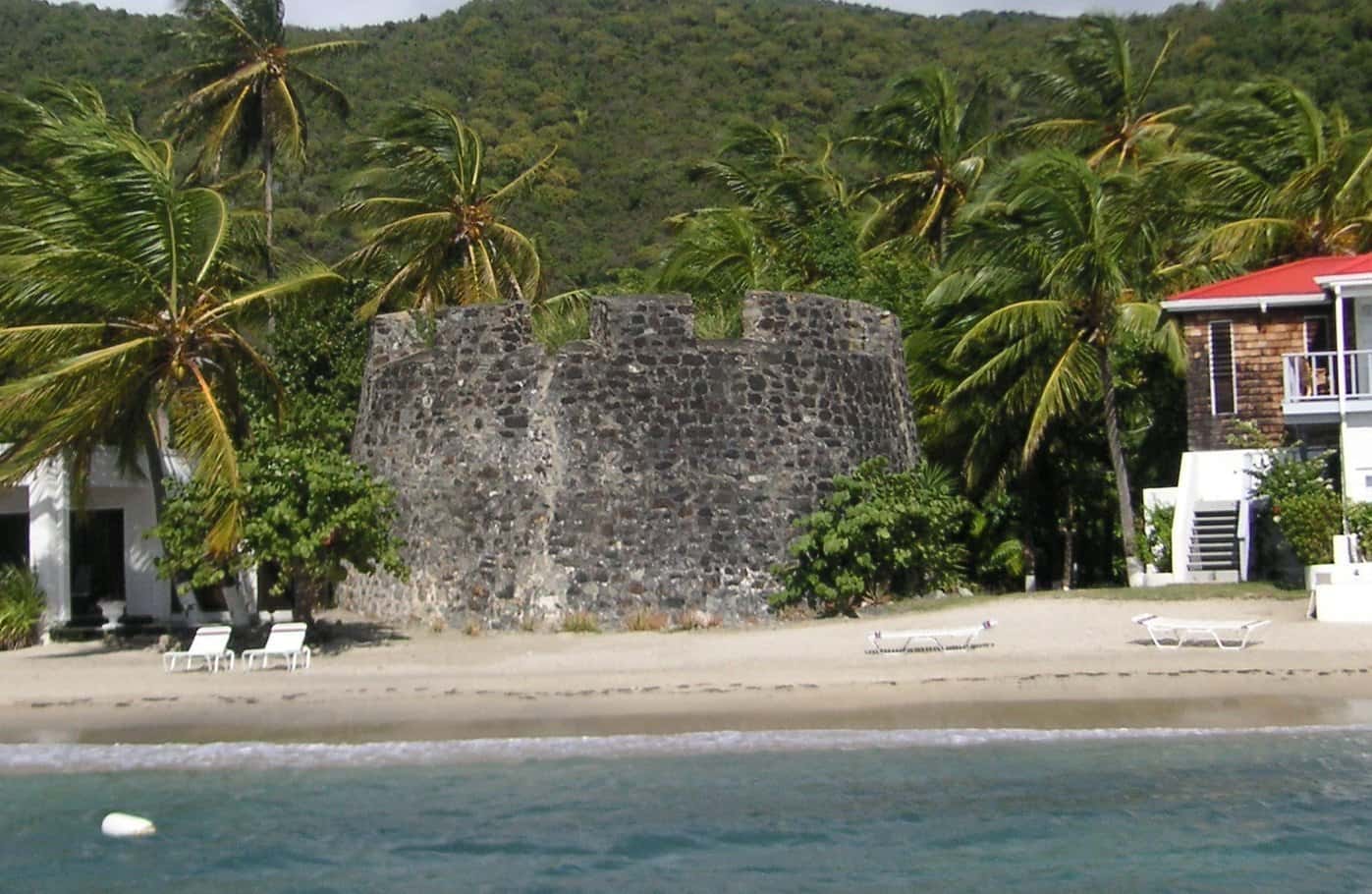
| Norman Island | Privately owned, about 610 acres, uninhabited Pirates Bight's description, checked 2026-10-16. No customs office; reached by boat. |
|---|---|
| The treasure | About 150,000 pieces of eight, buried mid-October 1750 Some 57,000 never accounted for, by the Danish West India and Guinea Company's letters. |
| Blackbeard nearby | December 5, 1717, off Crab Island (Vieques) A sworn deposition sent to London by Governor Walter Hamilton (Calendar of State Papers, vol. 30, no. 298). |
| The Dead Man's Chest | The name Stevenson took from Kingsley's list of Virgin Islands names Dead Chest lies inside the Dead Chest and RMS Rhone park, established 1980 (National Parks Trust of the Virgin Islands). |
| From Road Town | About 6 nautical miles to the Bight In a straight line, our read from the map. |
| Pirates Bight | 11 am to 9 pm daily, in season The season usually runs October to July; check with Pirates Bight before you go. Its own season listing, checked 2026-10-16. |
| The Willy T | Lunch 12 to 3 pm, dinner 6:30 to 9 pm A floating bar and grill in the Bight, by its own site, checked 2026-10-16. |
What the records say about pirates in the BVI
The best evidence for pirates in the Virgin Islands is the mail of the man who had to deal with them. Walter Hamilton, governor of the British Leeward Islands, reported to the Council of Trade and Plantations in London, and his letters survive in the Calendar of State Papers. On March 1, 1717 he wrote that HMS Scarborough had found pirates in the harbor of St. Croix on January 15, sunk their sloop and watched their ship, "a fine galley of about 26 guns", run aground and burn; about 20 escaped by night in a small sloop, and the rest were later "taken off by the sloop commanded by Bellamy".
That November Hamilton toured the British islands himself, and his letter of January 6, 1718 reads like a surveyor's notebook: Spanish Town, as Virgin Gorda was then called, held 54 men and not 2,000 acres of workable land; Tortola was mountainous and rocky with good timber; Beef Island had two families; Peter Island's harbor was fit only for sloops. Settlements that thin could not police their own water, and the next line of the letter shows it. Off St. Thomas a British sloop told him of a ship that had fired on it under British colors, then hoisted "a white Ensign with the figure of a dead man spread in it".
Blackbeard off the Virgin Islands, December 1717
Blackbeard was in these waters late in 1717, and the same letter names him. Two pirates had just taken trading sloops off St. Christopher's, "The ship is commanded by one Captain Teatch, the sloop by one Major Bonnett", with 22 or 26 guns mounted on a ship that all agreed could carry 40. Enclosed was the sworn statement of Henry Bostock, master of the sloop Margaret: on December 5, 1717, off Crab Island, the old English name for Vieques, "Capt. Tach" took his cargo of cattle and hogs, his arms, books and instruments. The ship, Bostock said, was a French slaver of 36 guns and 300 men, with a great deal of plate aboard, bound for Hispaniola to careen and wait for the Spanish treasure ships.
That ship was almost certainly La Concorde, the French slaver taken off Martinique late that autumn, per North Carolina's Queen Anne's Revenge project, which also notes that his real name is uncertain, usually some form of Edward Thatch or Teach. His career ended at Ocracoke Inlet in North Carolina in 1718. Nothing in the papers we read puts him ashore in the BVI. Blackbeard's Castle on St. Thomas is a name: the tower is Skytsborg, built in 1679 by the Danish governor as a watchtower, decades before Blackbeard sailed.
Norman Island's buried silver, 1750
Spanish silver really was buried on Norman Island in 1750, and here the legend has paperwork behind it. The Danish West India and Guinea Company's letters, now in the Danish national archive, carry the story. A Spanish ship, the Nuestra Señora de Guadalupe, was dismasted in a gale in 1750 and towed behind the Outer Banks of North Carolina; her captain moved the cargo into two hired sloops. Around the start of October, an Englishman named Owen Lloyd took the sloops and sailed south. Probably in mid-October they reached Norman Island and found 52 chests of Spanish silver in the hold, each of three bags of 1,000 coins, and buried about 150,000 pieces of eight ashore. A British court later put the whole cargo at more than 250,000 Spanish dollars.
It did not stay buried long. Abraham Chalwell, president of the island council on Tortola, went to Norman Island and seized goods and coins; Gilbert Fleming, Lieutenant-General of the Leeward Islands, wrote from Tortola to the Danish vice-governor on St. Thomas, where the crew had sold part of the cargo, asking for his cooperation; Lloyd was arrested on St. Eustatius. One crewman, William Blackstock, gave his examination on November 26, 1750. Some 57,000 pieces of eight have never been accounted for, and that gap is the whole of the legend that something is still there.
Treasure Island and the Dead Man's Chest
Norman Island is often called the model for Treasure Island. Stevenson never said so, and his own account points elsewhere. In his 1894 essay on writing the book, he listed what he worked from: a map he drew himself, a few memories of Poe, Defoe and Washington Irving, a copy of Johnson's Buccaneers, "the name of the Dead Man's Chest from Kingsley's At Last", and some canoeing. Charles Kingsley's At Last, from 1871, passes Virgin Gorda and complains that English buccaneers had given the islands "less poetic names. The Dutchman's Cap, Broken Jerusalem, The Dead Man's Chest, Rum Island, and so forth."
Dead Chest is the islet west of Salt Island, and since 1980 it has sat inside the National Parks Trust's Dead Chest and RMS Rhone park, 800 acres where anchoring and fishing are prohibited. The legend that Blackbeard marooned fifteen men there with a bottle of rum is the song's chorus grown into a story; no record we read holds it. The Norman Island link is a legend too, though a natural one: an island with buried pirate silver, a few miles from the rock that gave Stevenson his song.
Norman Island today: the Bight, Pirates Bight and the Willy T
Today the island is privately owned and uninhabited, by the description of Pirates Bight, the restaurant on the beach of the Bight, the bay on its west side with more than 100 moorings. The pirates live on as a theme. Pirates Bight opens for a season that runs from October to July; moored in the bay, the Willy T is a floating bar and grill, and the Willy T 2, the boat before it, now lies on the bottom as a dive site with pirate sculptures, sunk by Beyond the Reef. The Caves and the Indians, the snorkel and dive sites nearby, are where most day boats stop first. Hours for both businesses are in the facts above.
The tradeoff: the island is reached by boat only, a short sail from Road Town, and it has no customs office. A boat from St. John or St. Thomas clears into the BVI at West End first, with a passport for everyone aboard; from Tortola, a charter or a day boat does the work.
Questions about the BVI
Is Norman Island the real Treasure Island?
That is a legend. Stevenson's own account of writing Treasure Island names no real island; it credits a map he drew and takes one Virgin Islands name, the Dead Man's Chest, from Charles Kingsley's 1871 book At Last. Norman Island's link is that real Spanish silver was buried there in 1750, and some of it was never found.
How do you get to Norman Island?
By boat only. The Bight, its main bay, is about 6 nautical miles from Road Town in a straight line, reached by a charter, a day boat or a dinghy from a mooring. The island has no customs office, so a boat coming from St. John or St. Thomas clears into the BVI at West End first, with a passport for everyone.
Is the Willy T still at Norman Island?
Yes, as of October 2026: the Willy T's own site places its floating bar and grill in the Bight at Norman Island, serving lunch from noon to 3 pm and dinner from 6:30 to 9 pm, on VHF 16 and 74. The boat before it, the Willy T 2, was sunk as a dive site by Beyond the Reef.
Did Blackbeard come to the Virgin Islands?
To their waters, yes. A sworn statement Governor Walter Hamilton sent to London records "Capt. Tach" taking a sloop's cargo off Crab Island, now Vieques, on December 5, 1717, and the governor's letter places him off St. Christopher's days before. No record we read puts him ashore in the BVI.
Facts checked against the National Parks Trust of the Virgin Islands, Pirates Bight and the Willy T. Checked October 2026.