The US Virgin Islands flag, and what it means
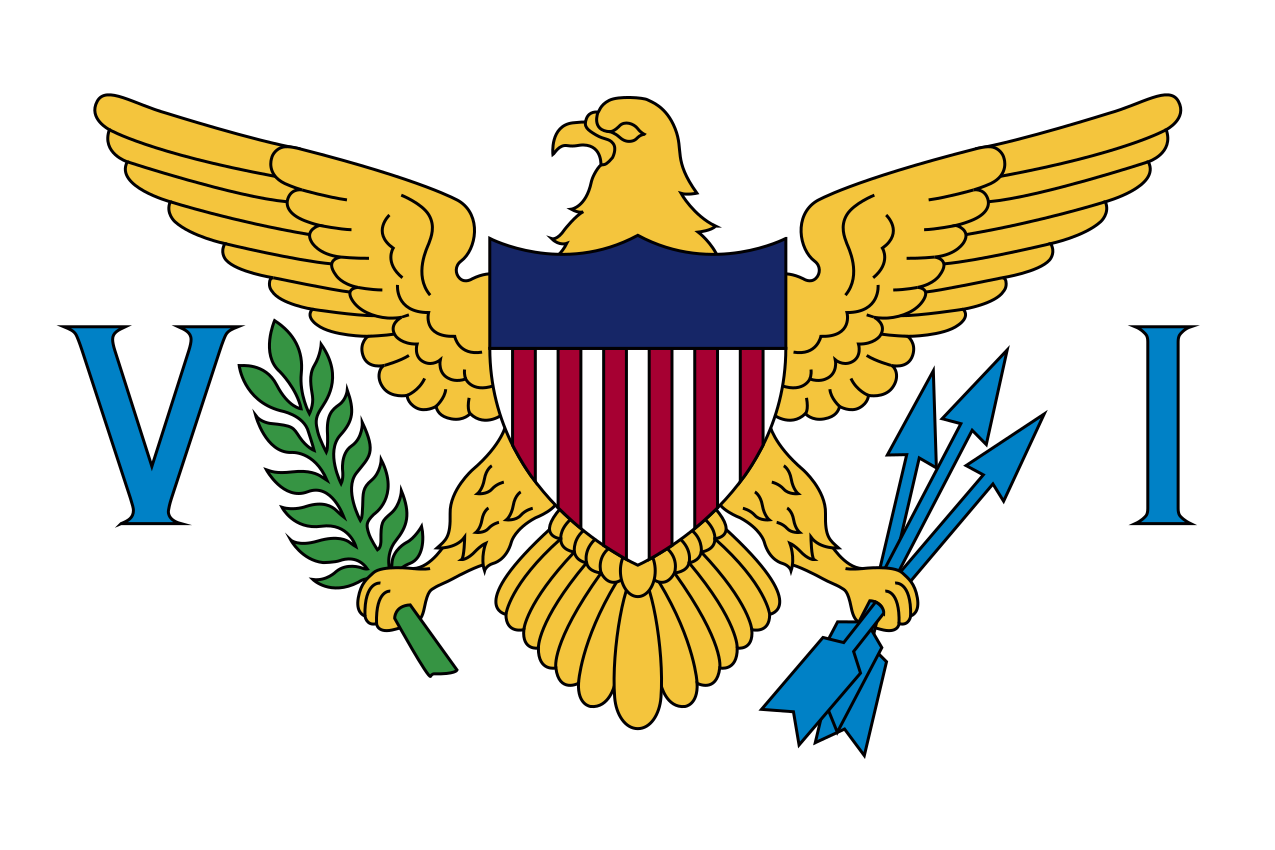
The US Virgin Islands flag is a white field with a yellow eagle between a blue V and I, the eagle carrying the shield of the United States, laurel in one talon and three arrows in the other. The design is written into the territory's law, and it is the one flag St. Thomas, St. John and St. Croix share.
| Prescribed by | Virgin Islands Code, Title 1, section 101 The 2025 edition, read October 2026. The section describes the design and carries no adoption date. |
|---|---|
| Adopted | 1921, by the governor's executive order May 17, 1921, under Governor Sumner Kittelle, by the usual account. No government page online in October 2026 states the order; the Code is silent. |
| Colors | White field, yellow eagle, azure blue letters and arrows, green laurel; the shield's chief the blue of the US flag The Code's own terms: argent, azure, vert. It names no shade for the yellow. |
| Proportions | Not stated in the Code Two to three, hoist to fly, in the common rendering, which is the drawing shown above. |
| The islands it covers | St. Thomas, St. John, St. Croix and Water Island One flag for the whole territory. No island has a flag of its own. |
| Beside it | The flag of the United States, above it or to its right 4 U.S.C. § 7, the federal flag code, read October 2026. |
| Half-staff | At the governor's order, on every public building Government House's order of June 9, 2026, is the pattern: Government House and all public buildings across the territory, sunrise to sunset. |
| Before 1917 | The Dannebrog, the flag of Denmark Lowered for the last time at 4 pm on March 31, 1917, per Government House (release of March 30, 2026). |
| The seal | A different design, since January 1, 1991 Virgin Islands Code, Title 1, section 108: the bananaquit on yellow cedar over the three islands, and no eagle. |
The flag as the Virgin Islands Code writes it
The USVI flag is one of the few in the United States whose every color is fixed by statute. Title 1 of the Virgin Islands Code describes it in the language of heraldry, element by element.
| Element | What the Code says | Color |
|---|---|---|
| The field | Argent | White |
| The letters V and I | Block letters, azure | Blue |
| The eagle | An American eagle, displayed | Yellow |
| The shield | The shield of the United States, on the eagle's breast | The chief the blue of the US arms and flag; the rest as the national arms draw it |
| The laurel | A sprig in the dexter talon | Green |
| The arrows | A bundle of three in the sinister talon | Blue |
Dexter and sinister are the eagle's own right and left, so the laurel hangs on the viewer's left and the arrows on the right, as on the Great Seal. Two sentences close the section, and they are the whole of the Code's color guidance: the blue of the letters and the arrows shall be azure blue, and the blue of the chief of the shield, its upper band, is the blue of the arms and flag of the United States. The Code sets no proportions and no shade for the yellow, so a printed flag and an embroidered one can differ a little and both be right. The common rendering, the one drawn above, is two to three, hoist to fly.
What the eagle, the arrows and the laurel mean
The Code describes and does not explain, so the meanings are the ones Virgin Islanders have given the design for a century, and we say them as that. The eagle and the shield are the arms of the United States, simplified: they say whose territory this is. The three arrows are read as the three main islands, St. Thomas, St. John and St. Croix, in place of the thirteen the national arms carry for the original states. The laurel is the old emblem of victory, the reading usually given, and the Code is specific that it is laurel, not the olive branch most eyes expect. The V and I stand for Virgin Islands, and nothing in the statute says more.
The tradeoff of borrowing the national arms is that the flag reads as the United States' before it reads as the islands'. The seal the territory adopted in 1991, with the islands themselves on it, is the government's own answer to that.
When the USVI flag was adopted, and by whom
The usual account runs like this. Rear Admiral Sumner Kittelle was sworn in as governor on April 26, 1921, in the years when the Navy ran the islands, and within weeks he asked for a territorial flag. Percival Wilson Sparks, a cartoonist, drew the eagle between the two letters and traced it onto cotton; his wife Grace and her sister Blanche Joseph embroidered the first one. Kittelle adopted it by executive order on May 17, 1921, the date every reference gives and the one the Legislature chose when a Senate committee approved a Virgin Islands Flag Day bill in October 2019.
What we cannot do is show you the order. The Code's section on the flag carries no date, the Flag Day bill is not in the Code's 2025 edition, and the government page that once stated the executive order is no longer online. So: 1921, by the governor's order, on every account we read, and no document of the day we could put in front of you.
The Dannebrog before 1917, and the US flag beside it since
Before the eagle there was the Dannebrog, the white cross on red that Denmark has flown for seven centuries. The islands were the Danish West Indies, and the Danish flag came down for the last time at four in the afternoon on March 31, 1917, the day the territory still keeps as Transfer Day, when the United States took possession under a treaty signed the summer before and paid $25 million in gold. The Stars and Stripes went up in its place, and for four years it was the only flag the islands flew.
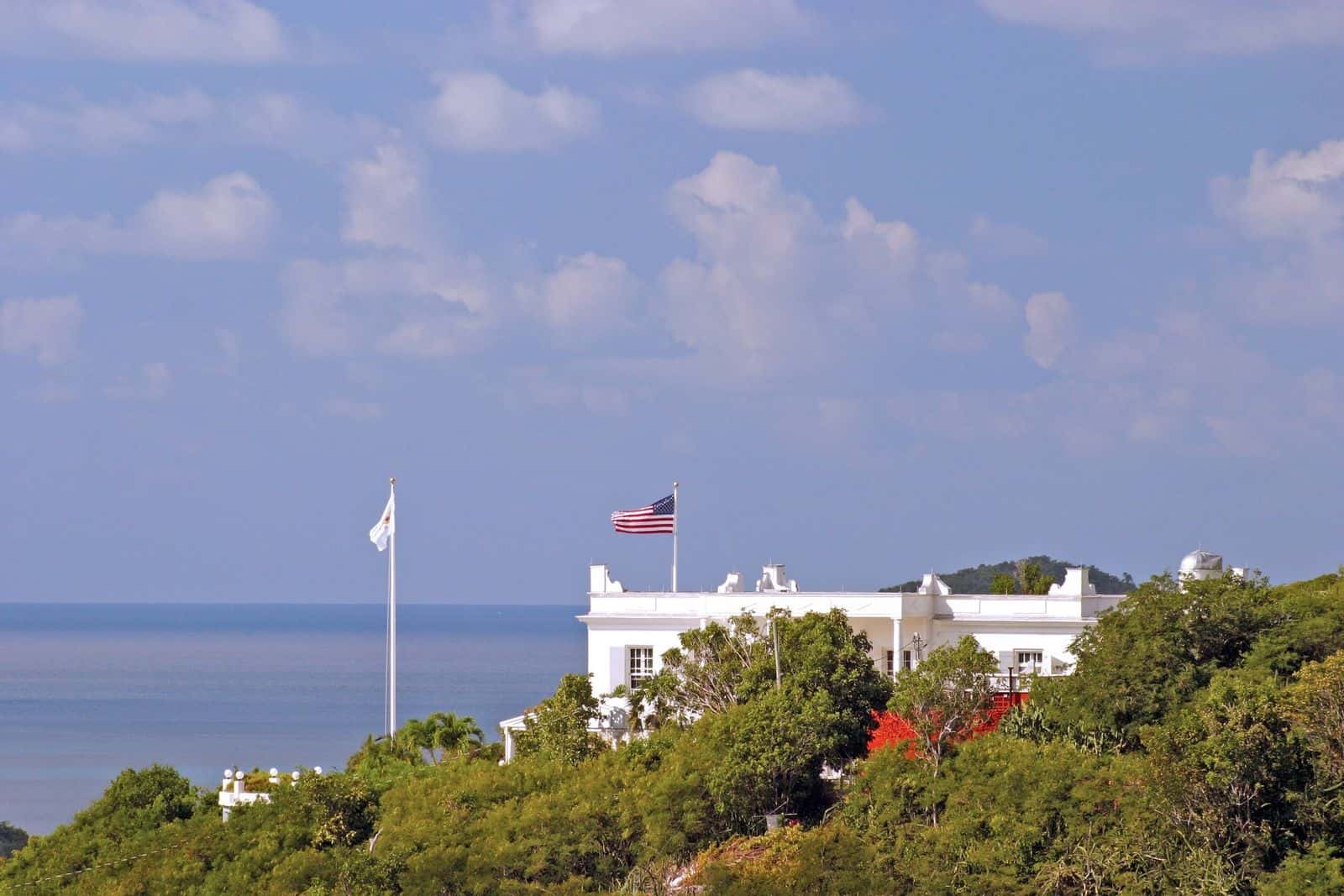
It still flies beside the territorial one, and federal law sets the order: under 4 U.S.C. § 7 the flag of the United States takes the highest point of any group, the peak of a shared halyard, and never sits below or to the right of another flag. The Virgin Islands flag flies under or beside it on every public building in the territory, and the governor is who orders it to half-staff; Government House lowered it from sunrise to sunset on June 10, 2026, for a former senator. The Code states no protocol of its own for the territorial flag.
The territory's seal is a different design
Search for the Virgin Islands flag and the seal turns up beside it, and the two are easy to confuse because the seal in use before 1991 was modeled on the Great Seal of the United States, the same eagle in a circle. The seal in use since January 1, 1991, has no eagle at all. The Code describes it in its own section: a yellow breast, the bananaquit that is the territory's official bird, perched on a branch of yellow cedar, the official flower, above three islands, one with a sugar mill for St. Croix, one with the Annaberg ruins for St. John, and one with the Capitol Building for St. Thomas, the flag of the United States and the Dannebrog behind it as they stood on Transfer Day. A scroll reads United in Pride and Hope. The St. Thomas artist Mitch Davis drew it.
The seal is the government's mark, on its stationery and its office doors, and the Code restricts its use. The flag is everyone's.
The British Virgin Islands flag, so you know which is which
A search for the Virgin Islands flag returns two, and they could hardly be more different. The British Virgin Islands, Tortola, Virgin Gorda, Jost Van Dyke and Anegada, are a British Overseas Territory and fly a blue ensign: a blue field, the Union Flag in the upper corner at the hoist, and the territory's arms in the fly, St. Ursula in white holding a lamp, eleven more lamps around her on a green shield, and a scroll reading Vigilate, be watchful. The saint and her companions are who Columbus named the islands for; the arms were granted in 1960.
The rule for a traveler is simple. A yellow eagle on white means the American side, where a US citizen needs no passport. A Union Flag in the corner means you have crossed to the British one, where the passport comes out, as the passport and entry guide explains.
Questions about the US Virgin Islands
Does St. Thomas have its own flag?
No. St. Thomas flies the flag of the US Virgin Islands, the yellow eagle between the blue V and I, as the whole territory does. The Virgin Islands Code prescribes one flag for the territory and none for an island, so a St. Thomas flag, wherever you see one, is the territorial flag.
What is the St. Croix flag?
The same one: St. Croix, St. John, St. Thomas and Water Island share the territorial flag and have none of their own. St. Croix does appear on the territory's seal, as the island with the sugar mill.
What do the three arrows on the Virgin Islands flag stand for?
By the usual reading, the three main islands, St. Thomas, St. John and St. Croix, in place of the thirteen arrows the arms of the United States carry for the original states. The Code itself says only that the eagle holds a bundle of three arrows, azure blue, in his sinister talon.
What does VI stand for on the flag?
Virgin Islands. The Code calls them the block letters V and I, in azure blue, one on each side of the eagle. USVI is the territory's usual abbreviation, but the flag carries only the two letters.
How do you tell the USVI flag from the BVI flag?
By the corner. The US Virgin Islands flag is white with a yellow eagle between a blue V and I. The British Virgin Islands flag is a blue ensign with the Union Flag in the upper corner and the arms with St. Ursula and her lamps in the fly. The eagle is the American side, the Union Flag the British one.
Can the US Virgin Islands flag fly with the US flag?
Yes, and it does on every public building in the territory. The federal flag code, 4 U.S.C. § 7, puts the flag of the United States at the top of a shared halyard and at the highest point of a group, never below or to the right of another flag, so the territorial flag flies under it or to its left as you face them.
Facts checked against the Legislature of the Virgin Islands, Government House, the National Archives and the US Government Publishing Office. Checked October 2026.