
Virgin Islands National Park
Virgin Islands National Park is on St. John, in the US Virgin Islands, and the National Park Service puts almost 58 percent of the island's land inside it. Entry is free and the park never closes; only Trunk Bay charges, $5 per person 16 and over as of October 2026. Below: each place, and the route from Cruz Bay.
Written by Virgin Islands Villas · Facts checked Oct 2026
The North Shore beaches, Caneel to Francis Bay
From Cruz Bay, the nearest park beach is Caneel, 7 minutes by car. North Shore Road then runs east along the park's North Shore, and every stop below is reached by car, at no charge except Trunk Bay. The minutes are ours, measured to each lot on island roads.
| Place | How you get there | From Cruz Bay | What decides it |
|---|---|---|---|
| Caneel Beach | By car to the old resort's public lots | 7 min | Open by land since August 1, 2024; lots open 7 am to 5 pm |
| Hawksnest Beach | By car to the roadside lot | 8 min | Three elkhorn reefs; the park says the lot often fills by mid-morning |
| Denis Bay | By car to the Peace Hill lot, then 4 min on foot | 10 min | No facilities; closed to commercial boat groups |
| Trunk Bay | By car to the lot at the fee booth | 13 min | The $5 fee and the underwater trail |
| Cinnamon Bay | By car to the campground lot | 17 min | One of the park's longest beaches |
| Maho Bay | By car to the roadside beach | 18 min | Sea turtles over seagrass; 33 parking spaces |
| Francis Bay | By car to the end of the road | 25 min | The park calls it one of its quieter areas |
The tradeoff is the parking. The National Park Service says every beach and trailhead lot fills quickly and publishes a space count for one of them, Maho's 33, so the early start is the plan, not a tip.
Trunk Bay, the one stop that charges
By car: 13 minutes from Cruz Bay to the lot at the fee booth.
Trunk Bay is the only place in the park with a fee, an amenity fee of $5 per person aged 16 and over, sunrise to sunset, which the park's fee-free days do not waive. The fees page, last updated September 29, 2026, says no cash is taken there from October 1, 2026, card and mobile payment only; the same page's passes section still says cash payments for passes are accepted at Trunk Bay. Carry a card and you need not settle which line is current.
The fee buys what the free beaches lack: showers, a snack bar open 10 am to 4 pm on the park's hours page, rentals, and the marked underwater snorkel trail off Trunk Cay. It does not buy a lifeguard; the park says none is on duty.
Cinnamon Bay campground, the only camping in the park
By car: 17 minutes from Cruz Bay to the campground lot, then a walk through the campground to the sand.
St. John camping in the park means Cinnamon Bay and nowhere else. The 2026 Superintendent's Compendium, updated October 6, 2026, permits camping only in the marked sites of the Cinnamon Bay Campground, during the periods it operates. The park's campground record has it closed in September and October and open the rest of the year, usually from November, with 121 sites, bare sites at $50 a night and eco-tents from $190 as of October 2026. A concessioner runs it and takes the bookings, not the park, so ask the operator when it reopens before you plan an early-November stay.
Annaberg and Waterlemon Cay: a drive, a walk, a swim
By car, then on foot: about 27 minutes from Cruz Bay to the Annaberg lot, then the Leinster Bay Trail.
The Annaberg Sugar Plantation ruins sit above Leinster Bay, and the same lot serves the shore walk east to Waterlemon Cay. The park allows ten minutes to the first strip of sand and ten more to the main beach; the cay itself is a swim out from the end of that path. The park publishes no swim distance and says to keep to the cay's southern side, away from the current on its north face.
Neither stop lists a restroom, water or food on the park's pages. Fill bottles in Cruz Bay before the drive.
Solomon and Honeymoon: the beaches no road reaches
On foot: 16 minutes to Solomon and 17 to Honeymoon from the park visitor center in Cruz Bay, by the Lind Point Trail, as we measured them.
These two are the park's walk-in beaches. The trail starts behind the visitor center, which is 8 minutes on foot from the ferry dock, so a day here needs no car at all. The park calls the trail narrow and rocky and allows 20 to 40 minutes, longer than our map pace, and says it does not suit a stroller. Honeymoon can also be reached by boat.
Park at the trailheads only: the visitor center desk gives a parking pass in its weekday hours, or use the gravel lots on North Shore Road.
The south shore: Salt Pond Bay, Ram Head and Lameshur
By car, then on foot: 41 minutes from Cruz Bay to the Salt Pond lot and a 10 minute walk down; 45 minutes to Little Lameshur.
The south shore is the far side of the island, through Coral Bay, and the longest drives on this page. From Salt Pond Bay the Ram Head trail runs 0.9 mile one way, steep and strenuous by the park's own description. Salt Pond has restrooms and no drinking water on the park's list.
Lameshur is two bays, rocky Great Lameshur and sandy Little Lameshur, at the end of a rocky road on which the park recommends four-wheel drive. The park says many car rentals prohibit it, and as of October 2026 a rebuild that would close the road is pending, so ask the rental company and phone the visitor center before you set out. The Reef Bay Trail, which the park describes running down to petroglyphs and an old sugar mill near a beach, is the hiking subject of its own.
How do you get to Virgin Islands National Park?
By ferry, then by car or on foot: there is no airport and no bridge on St. John. Fly into St. Thomas, take the Red Hook ferry to Cruz Bay, 20 minutes, and walk 8 minutes from the dock to the park visitor center at Cruz Bay Creek. No entrance pass is needed.
A car opens every drive-up place on this page, and the park's own reminder applies the moment you leave the lot: Virgin Islands drivers keep left. The Lind Point beaches are the exception that needs none.
By water, the park sells overnight moorings at $26 a night, paid at stations in Cruz Bay, Caneel Bay, Francis Bay, Leinster Bay, Salt Pond Bay and Great Lameshur Bay, with seven nights per bay and 30 a year at most, as of October 2026. Without a boat of your own, the park points to private operators that run day sails and snorkel tours.
Park rules on the beaches and trails in 2026
The rules that catch visitors are in the 2026 Superintendent's Compendium, which the National Park Service updated on October 6, 2026. Pets are not allowed on park beaches. Glass bottles and containers are banned on every park beach. Flying a drone anywhere in the park needs the superintendent's written approval. Nudity is prohibited on all park beaches, and the park may close a swimming or snorkel spot for safety or to protect it.
The park's hiking page asks for half a gallon of water per person for every four hours on a trail, and sturdy shoes. None of the walk-in beaches sells water.
- Where is Virgin Islands National Park?
- On St. John, in the US Virgin Islands, a 20 minute ferry ride east of St. Thomas. The National Park Service puts almost 58 percent of the island's land inside the park, which also holds 128 acres on Hassel Island in Charlotte Amalie Harbor. The visitor center is at Cruz Bay Creek, 8 minutes on foot from the St. John ferry dock.
- How do you get to Virgin Islands National Park?
- Fly to St. Thomas, take a taxi to Red Hook and the passenger ferry to Cruz Bay, 20 minutes. The park visitor center is an 8 minute walk from the dock. From there, the Lind Point Trail beaches are on foot, and the rest of the park is a drive of 7 to 45 minutes by our measurement.
- What state is Virgin Islands National Park in?
- None. The park is in the US Virgin Islands, a United States territory, not a state, on the island of St. John. It is run by the National Park Service, like the parks on the mainland, and was established in 1956.
- How much of St. John is national park?
- Almost 58 percent of the island's land, 7,259 acres, on the National Park Service's page for the park, updated April 2023. The park's home page says two-thirds; the Park Service reaches that figure by adding 5,650 acres of submerged land to the 7,259 on shore.
Villas near Virgin Islands National Park
All villas on St. John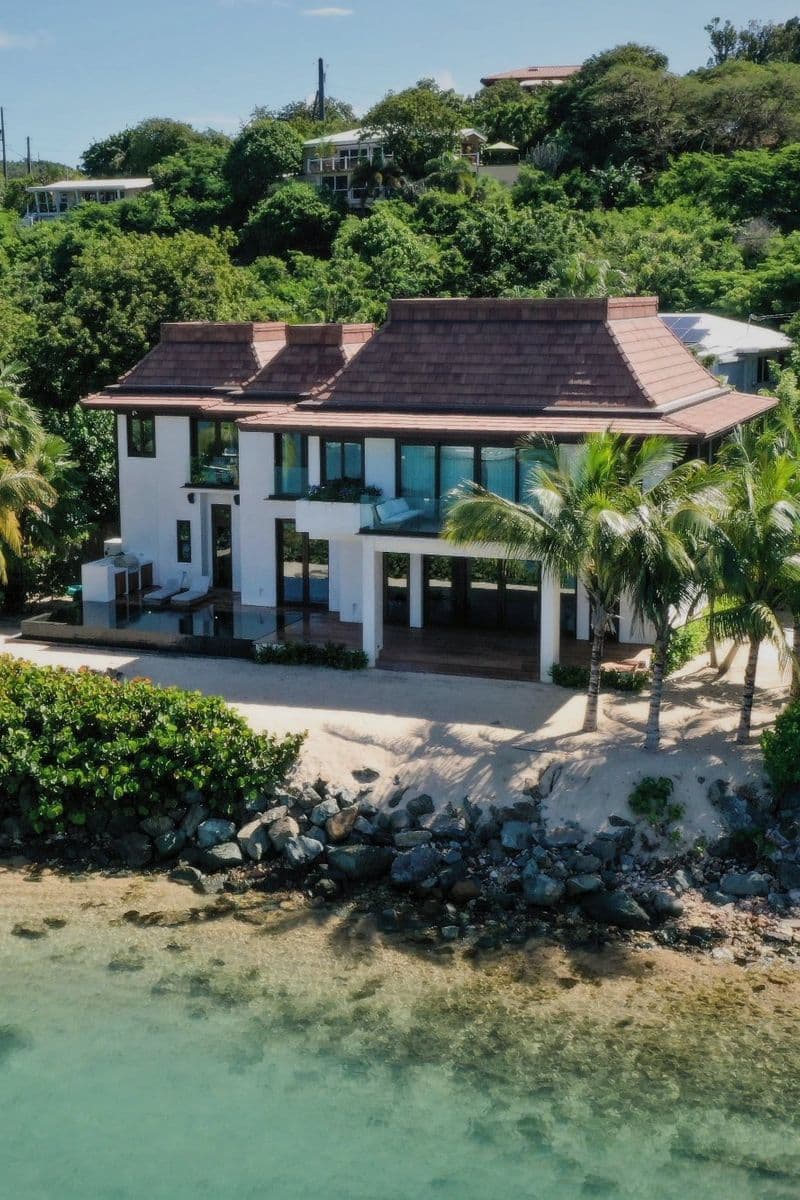
Drive times are estimates for island roads.
- Things to do in St. John
- Cruz Bay to Jost Van Dyke
- Hiking on St. John: the Reef Bay Trail and six more
- Scuba diving on St. John, Virgin Islands
- St. John snorkeling, from the beach and by boat
- A St. John honeymoon, decided by the house and the road to it
Facts checked against the National Park Service. Checked October 2026.